
The brain, its waves and meditation
Anurag Gaeta

Brain waves and meditation
Last month, during training I listened to one of Osho’s speeches. It was so powerful it compelled me to understand better what meditation can do for the brain.
Osho’s speech title was, "Enlightenment is just around the corner".
In this speech, Osho describes the four states of conscience. The highest is enlightenment or illumination, also known as Turiya. This is the state in which you are truly awakened. Osho praises Patanjali - one of the first Yoga scholars and author of the seminal text Yoga Sutras - as the first and undisputed scientist of the soul.
Starting from these first three states of conscience we can only roughly understand what enlightenment is. The three states preceding complete enlightenment belong to the mechanical man.
States of conscience
The first stage is sleepiness. We all know it. Every night we experience our body as it falls unconscious and goes into rest mode.
Dreaming is the second phase. The psychic process of our experiences takes place unconsciously.
Last but not least we find the conscious state. Despite its name it remains a state of darkness. We literally comprehend only what our prejudices, judgments and beliefs allow us to see. The mind's eye filters reality through family and social conditionings which form what we call personality. This is the most powerful filter which gives form to our biased experience of life.
Meditation as a way to enlighten our life
Meditation makes you realize that conscience is just another dream-like state. The only real difference is that in this day-dreaming state, you are actually doing something. And as we do, thoughts creep in and take us away from reality. They insulate us from the present that happens before our very eyes and senses. We go automatic. Without even realizing it, we take our way of acting, of feeling, of perceiving for granted. All our vital sensors dim as we perceive only the facets of reality that our filtered-mind makes us see.
While I am doing something you get carried away and think about what you’ll have to do later in the afternoon. Maybe I am washing the dishes and I go back in time to mull over what I should have done differently. I survey my desires pondering what's going on and what's wrong with my life.
To an outside observer, it may seem that I present here and now. In fact, I am actually somewhere else in a different time!
Practicing meditation must start from this premise: we are open-eyes sleepwalkers. It’s meditation that leads to awakening. Being in the here and now, with no past and no future distracting you, is the only state of mind that can shed light on reality. And this process entails actively seeing everything more comprehensively.
Meditation involves removing all filters. That's what Osho means with the sentence, “enlightenment is just around the corner”. Meditation allows you to wake up from the deep-seated sleep state in which your mind is plunged into.
Waking states and effects of meditation
The techniques invented by Osho are more suitable than traditional meditation methods. They are designed for the contemporary person, who lives constantly torn between desire and frustration. That’s why practicing an active Osho meditation quickly soothes the brain. (by the way, if you want to learn about Osho's techniques, go to our website page: click here)
In fact, meditation shapes our brain activity. It allows us to contact our creativity, our inner peace, and connect with ourselves. Furthermore, it lets us create the conditions to see better and illuminate our lives. Lately, science has researched the effects of meditation on our brains and the findings are extremely illuminating.
Brain waves and lobes involved
Like everything in life, the brain’s activity fluctuates between a yin-yang polarity in the form of waves. Such electrical activity produces 5 brain waves along different frequencies. They signal different sleep-wake states and are classified as follows:
Gamma waves range from 30 to 42 Hertz and show states of particular tension;
Beta waves, from 14 to 29.9 Hertz, indicate intense activity of the mind;
Alpha waves, from 8 to 13.9 Hertz, belong to receptive states like listening, reading or when we relax in meditation;
Theta waves range from 4 to 7.9 Hertz. The Theta state is one of deep relaxation and signals the transition from wake to sleep. This is the state one ought to delve into seeking out a radical change.
Delta waves, from 0.1 to 3.9 Hertz, characterize the states of deep sleep.
Gamma or Beta waves keep us nervous and grumpy, while meditation helps the brain find relaxation.
What happens during meditation
Let's now unpack how meditation can rewire our brain.
Each side of the brain contains four associative areas. Each area is connected to a particular lobe of the brain. The figure below can help you identify their location.
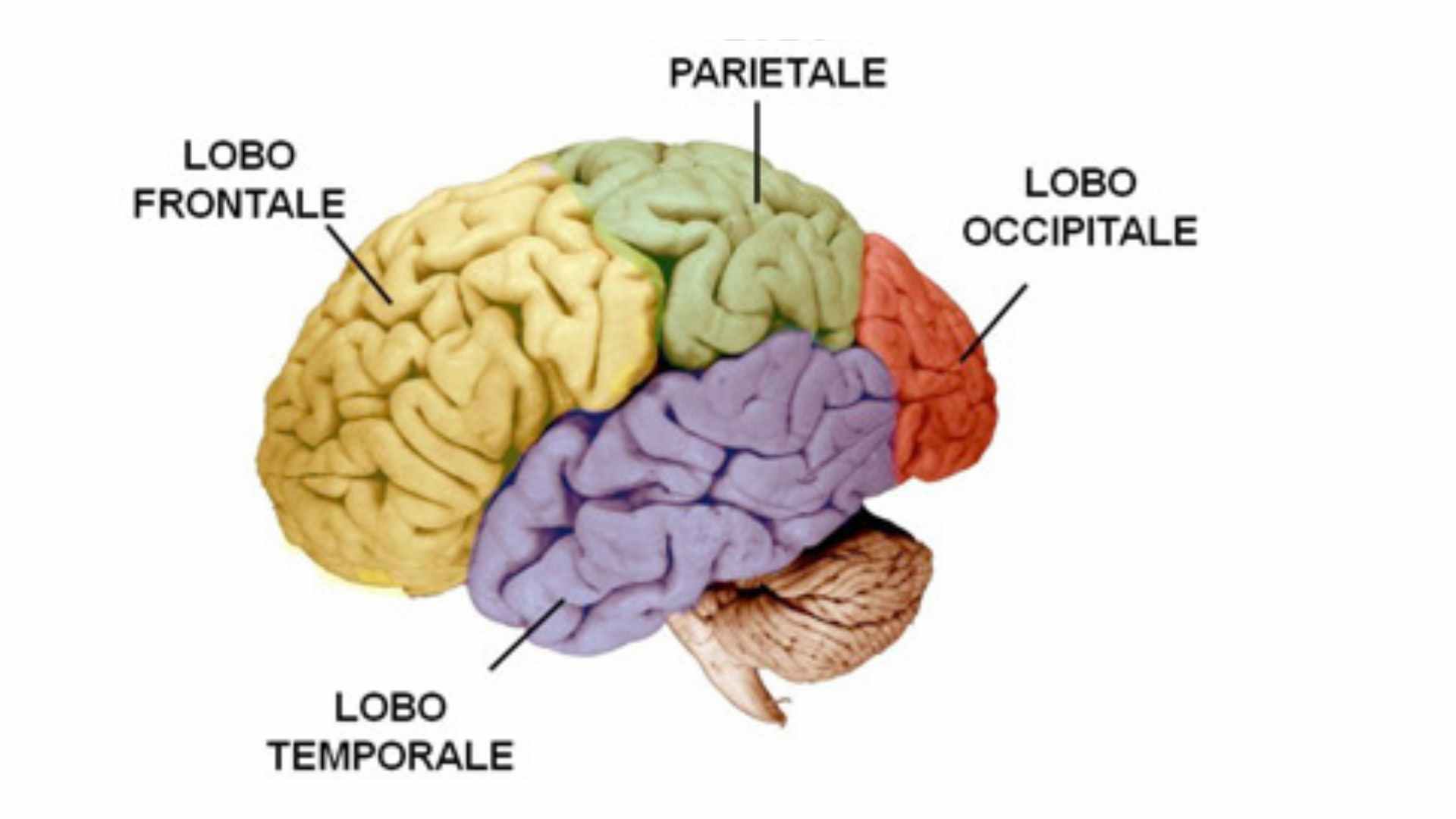
The frontal lobe is important for cognitive functions and control of voluntary movement or activity.
The parietal lobe processes information about temperature, taste, touch and movement;
Occipital lobe is primarily responsible for vision.
The temporal lobe processes memories, integrating them with sensations of taste, sound, sight and touch
When we meditate, the brain switches to Alpha and Theta waves. The electrical activity is lessened and consequently brain waves’s length ranges between 4 and 14 Hertz. As simple observers we become more receptive.
We expand the boundaries of time and space connected to the parietal lobe. In this area the brain works out the distinction between self and what is different from it. By meditating, we break down the borders of our Self and perceive harmony with the whole.
The attention / tension activity, belonging to the frontal lobe, is softened. Meditation leads us to observe internal phenomena or a sound or breath. Through relaxation the attention span is heightened.
The temporal lobe is associated with visual inputs. During meditation its focus is inward, towards inner vision. Life’ events and experiences, as well as emotions, can be processed and soothed through disidentification.
The occipital area also reduces its activity. In fact, we do not need to put into words what happens, when we meditate. Such interior experience doesn’t need logical or mental explanation. Finally, the mind, always eager to pin down every single aspect of reality, has little to say.
Meditation leads us to create more and more Alpha and Theta states - between 4 and 14 Hertz - and to live a less stressful life. It leads us to improve attention to internal phenomena and the meaning they have produced for us. A sense of closure pervades the brain which thus eliminates the tension caused by neglected or repressed emotions.
Tension means nothing more than striving for something. It holds no negative meaning per se. A prolonged state of tension is the problem. The most harmful tension is unconscious because it flings us to the future or binds to the past. Desire is a constant tension towards something missing, that either does not yet exist or has not existed.
Desire turns into craving and soon after it becomes frustration which brings us into states of Beta or Gamma tension. The past makes the mind spin aimlessly, looking for a solution that is nowhere to be found: this is how the brain remains in a state of constant tension.
Unfortunately, we are not taught to be relaxed. To do that we ought to immerse ourselves in alpha waves by being present and observing the here and now. Beta waves are supposed to function only during special efforts. And as for Gamma waves, those should only be reserved for exceptional cases.
But we strongly identify with what we do when we are active and awake. We take up a personality and hold it before others in society. This takes us away from a state of natural relaxation and enjoyment of life.
On the other hand, meditation leads to the so-called “Alpha state”. We may think we’re doing nothing, but this nothing is actually healing. It is a state unknown to most. We seek things to do so that we can find meaning to our life. Life’s meaning can be actually found in an effortless state of relaxation.
In reality, Alpha waves allow us to experience life at its simplest form. Not by chance, Gautama the Buddha, achieved enlightenment by meditating in an extensive bath of Alpha waves. Reaching this state is not that difficult. It is a matter of practice. Perhaps, this is why Osho suggested that enlightenment is just around the corner.
Meditation, Theta waves and transformation
Relaxation is key to change. Thus we shall ask, how can change take place in our minds? We need to access our learning patterns and rewrite them. And it is just the Theta states of mind which allows a profound rewiring of the brain’s old patterns.
When we meditate, such a process happens regularly if we persistently observe our ordinary behavior patterns. In our everyday life the automatic patterns of behaviour presides over our actions, formed and conditioned by our learning procedures. To unlearn it, you need to soothe your mind. The first step is to observe without judgment what the mind brings up, moving from known patterns to a creative state of no-mind.
Judgment is an essential component of our conditioning and to disarm it we must plunge our mind into a Theta state.
Willpower alone can not bring about change. Actually, it mostly leads to superficial and frustrated forms of disruption. The ingrained mechanisms remain unscathed, in the depths of brain memories, ready to re-emerge as soon as you lose control. On the other hand, it is necessary to enter a state of vigilant observation to allow change to blossom freely. And this is exactly what happens with meditation!
Most people sleep for 6 to 8 hours and live in a constant state of tension for the rest of the day… The answer to dissolve that tension is very simple, “just meditate!”.
Meditating is a pathway to seeing the world and yourself in the very present. But it requires perseverance and dedication ... at least one hour a day, or 10 minutes every hour! And rather than finding excuses, just observe yourself: the time you think you don’t have is just being just allocated to activities that will elicit Beta and Gamma waves.
Put meditation at the top of your priorities every day... because the corner Osho talks about can be right under your nose.


© 2018 | OSHO TAO ESSENCE INSTITUTE | P.IVA 04345370961 | DesignOjasAzzaro | Development OSHO is a registered trademark of Osho International Foundation, used with permission.


